product
Amazon DSP: Advertise with a demand-side platform
GUIDE
Ad inventory refers to advertising space that’s made available for purchase. This includes ad spaces across websites and mobile sites, mobile apps, video platforms, audio and podcast content, connected TV (CTV), and streaming services.
Register with Amazon Ads to display your products and create campaigns.
Request managed services. Budget minimums apply.
Programmatic advertising to reach audiences at scale.
Ad tech solutions to support full-funnel marketing goals on or off Amazon.
Ad inventory represents the ad space available for purchase by advertisers and can significantly influence the way brands reach targeted audiences. This guide aims to unravel the complexities of ad inventory and its importance for both publishers and advertisers.
Ad inventory refers to the space or time slots available for advertisements on various platforms, such as websites, mobile apps, and other digital media. It serves as the bridge between publishers who own ad space and advertisers eager to reach specific audiences through display ads, video content, or native advertising.
Ad inventory is important because it determines what ad space is available, where it appears, and at what cost. This helps both advertisers and publishers achieve the following:
For publishers, effectively managing ad inventory ensures higher revenue through optimized ad placement and sales.
Advertisers can utilize ad inventory to reach specific audiences, enhancing connection opportunities through tailored messaging.
Understanding metrics related to ad inventory allows both parties to gauge performance and adjust strategies accordingly.
Ad inventory integrates with the ad tech landscape through a complex network of solutions and technologies that connect publishers (who have ad space) with advertisers (who want to reach audiences). Here's how it works:
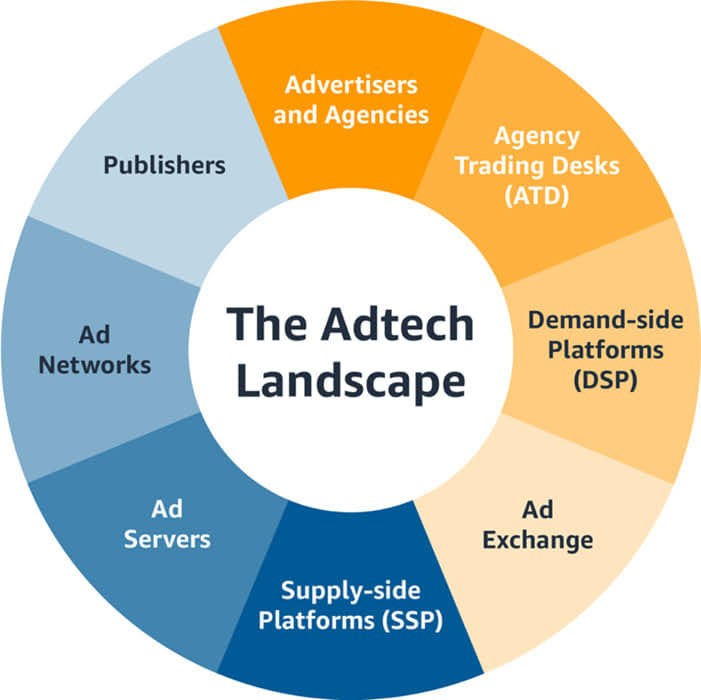
Advertisers and agencies use a range of ad tech solutions, including agency trading desks (ATD), demand-side platforms (DSPs), ad exchanges, supply-side platforms (SSPs), ad servers, ad networks, and publishers.
SSPs connect publishers' ad inventory to the broader landscape. Publishers use SSPs to make their available ad impressions accessible to potential buyers across multiple ad exchanges, demand-side platforms, and ad networks simultaneously.
DSPs sit on the advertiser side, helping them discover and bid on available inventory. DSPs connect to ad exchanges and SSPs to access inventory from multiple publishers through a single interface.
Ad exchanges serve as the central marketplace where inventory transactions occur. They facilitate real-time bidding (RTB) auctions, connecting supply from SSPs with demand from DSPs.
The ad tech landscape supports several integration approaches, including real-time bidding, direct sales, private marketplace, and header bidding.
This method uses automated auctions where inventory is sold impression-by-impression in milliseconds as users load pages.
This approach involves pre-negotiated deals where inventory terms are defined before ad slots become available.
This model creates invitation-only auctions where select advertisers bid on premium inventory with pre-negotiated terms.
This technology allows multiple demand sources to bid on inventory simultaneously before the publisher's ad server makes a decision.
Different types of ad inventory exist within digital advertising, each serving distinct purposes for advertisers and publishers.
Premium inventory includes high-demand placements that typically yield greater cost-per-mille (CPM) values due to their visibility and audience quality.
Remnant inventory refers to unsold ad space often offered at lower prices, providing advertisers with budget-friendly options.
Mobile ad inventory refers to ads presented within applications, specifically engaging mobile users where they spend significant time.
Calculating ad inventory involves understanding key metrics, including page impressions, fill rate, and estimated CPM.
Buying and selling ad inventory involves various approaches that define how advertisers and publishers establish pricing, access, and transaction terms.
Managing ad inventory presents several challenges as digital advertising evolves, including fraud prevention, privacy compliance, and data visibility.
Mitigating the risks posed by invalid traffic and fraudulent impressions is essential for maintaining inventory integrity.
As regulations around cookies evolve, understanding consumer consent becomes increasingly critical.
Data fragmentation complicates measurement and visibility across campaigns, making optimization difficult.
An effective ad inventory strategy requires strategic approaches that balance operational efficiency, audience reach, and user satisfaction to maximize both revenue and campaign performance.
Leveraging automated systems, such as ad servers, supply-side platforms, and inventory management software, can help streamline the buying and selling process, reduce manual errors in pricing and placement decisions, and enable real-time optimization that improves fill rates and revenue potential.
Using various ad formats—including video, display, and native—helps reach broader audiences across channels while providing flexibility to match advertiser objectives and user preferences throughout the customer journey.
Creating ads with the user experience in mind can lead to better engagement rates, higher completion rates, and reduced ad fatigue, ultimately protecting the long-term value of your inventory.
Within Amazon Ads, ad inventory integration connects advertisers with premium publisher inventory through specialized services and tools. This integration is supported by infrastructure including ad servers for campaign management, data management platforms (DMPs) for audience targeting, and measurement systems for tracking performance.
Amazon Publisher Services (APS) provides publishers with access to demand from Amazon DSP and third-party exchanges, along with tools for inventory management, supply intelligence, and collaboration capabilities that make their inventory available to advertisers through Amazon DSP.
Amazon Ads established relationships with premium publishers that got the industry talking: partnerships with Roku, Disney, Netflix, Spotify, SiriusXM, iHeartMedia, Microsoft, and more. These integrations position Amazon DSP as the largest provider of authenticated streaming TV reach while also further expanding into premium audio. The outcome? More efficient campaign planning, industry-low fees, and powerful signals that help advertisers reach the right customers while reducing media waste.
Behind these partnerships is sophisticated technology that helps advertisers maximize their investment. "When we’re buying ad inventory on third-party exchanges, we use sophisticated ML models to secure the best ad inventory for our customers at the lowest possible cost, which improves their business overall," said Ben Allison, director of applied science display at Amazon Ads. "The amount of information we use to find the best opportunities for our advertisers is vast: real-time signals about page content, media and creative, and our audiences, and how they engage with ads. AI helps us innovate: As we double down on AI and optimization, we are able to deliver ad experiences that are more delightful for viewers and shoppers, and more likely to grow our advertisers’ businesses over time."
Amazon Ads and Disney Advertising’s strategic integration between Disney's Real-Time Ad Exchange (DRAX) and Amazon DSP enables advertisers to access Disney's premium content inventory across Disney+, ESPN, and Hulu while leveraging combined insights from both companies for more targeted audience reach.
Amazon Ads and iHeartMedia’s partnership allows advertisers to access iHeart's streaming audio portfolio, including music and live radio, across multiple devices such as smartphones, smart speakers, and tablets, with access to iHeartPodcasts and broadcast radio stations added in 2026.
Amazon and Microsoft have established a strategic partnership in which Amazon DSP has been designated as the preferred transition partner for Microsoft Invest customers, with Microsoft shifting away from media buying through its own DSP. Amazon will support the migration of Microsoft Invest customers across North America, Latin America, Europe, and Asia-Pacific regions. Additionally, Microsoft Monetize has been added as a preferred SSP to Amazon's Certified Supply Exchange program, giving Amazon DSP advertisers more efficient access to Microsoft Monetize's open internet inventory and exclusive deal packages, including Amazon Shopper Insights packages that combine Amazon's shopping data with Microsoft inventory.
Amazon Ads and Netflix’s strategic partnership allows advertisers using Amazon DSP to access Netflix's premium ad inventory directly. The partnership was made available in Q4 2025 across 11 countries: the United States, United Kingdom, France, Spain, Mexico, Canada, Japan, Brazil, Italy, Germany, and Australia.
Amazon Ads and Roku's partnership provides advertisers with access to the largest authenticated Connected TV (CTV) footprint in the U.S. through Amazon DSP. The exclusive partnership between two leaders in CTV enhances addressability across major streaming apps including The Roku Channel, Prime Video, and other leading CTV streaming services on Roku and Fire TV operating systems; popular streaming services including Disney, FOX Corporation, Paramount+, Pluto TV, Tubi, and Warner Bros. Discovery; and all premium publishers. The partnership utilizes a custom identity resolution service allowing Amazon DSP to recognize logged-in viewers across the Roku OS and devices, enabling advertisers to reach the same viewer deterministically across different streaming channels and devices.
Amazon Ads and SiriusXM Media’s strategic partnership integrates programmatic audio advertising through Amazon DSP. This integration allows marketers to access SiriusXM Media's digital audio portfolio, including Pandora and SoundCloud U.S., reaching 160 million monthly digital listeners for the first time through a single platform. The offering includes activation of SiriusXM's streaming music portfolio via the AdsWizz Supply Side Platform, with expansion to the SiriusXM Podcast Network (which ranks #1 among audiences 18+ and includes four of the top ten podcasts), and the ability to pair Amazon's first-party shopping, streaming, and browsing insights with SiriusXM's premium audio content for targeted audience reach.
Amazon Ads and Spotify’s global strategic partnership integrates Spotify's streaming audio and video inventory with Amazon DSP. This integration enables advertisers to access Spotify's users through Amazon DSP's programmatic platform, combining Amazon's shopping and browsing signals with Spotify's engaged audience for omnichannel advertising campaigns.
Case Study
Sports Research partnered with Pacvue and Amazon Ads to launch their new Hydrate electrolytes product through an Amazon Publisher Cloud (APC)-enabled programmatic guaranteed deal that combined custom Amazon Marketing Cloud (AMC) audiences with premium streaming TV inventory from a leading broadcaster. The APC-enhanced deal reached the intended audience at a rate 1.8 times higher than the benchmark while using 56% less spend and driving 43% more impressions compared to the control campaign, demonstrating how APC helps advertisers access premium ad inventory with advanced audience targeting and cost efficiency.

Case Study
Paramount Automotive partnered with Spectrum Reach to implement a streaming TV advertising strategy that leveraged Auto Analyzer, a proprietary analytical tool from Spectrum Reach, for insights-driven targeting, custom creative production, and premium streaming inventory including Amazon Ads placements to reach new audiences across North Carolina. The campaign achieved record vehicle sales in November 2024 and realized 30% year-over-year market share growth, leading to expansion across three additional dealership locations.

Case Study
Renewal by Andersen partnered with Spectrum Reach to develop a comprehensive streaming TV advertising strategy that leveraged premium streaming inventory, including Amazon Ads, with detailed heat maps and zip code-level targeting to identify coverage gaps across Wyoming's vast service territory. The campaign reached over 300,000 new consumers and achieved 100% coverage across all desired zip codes in their service areas, with significant increases in leads during advertising periods.

The potential of ad inventory extends beyond simple definitions; it encompasses strategic approaches to enhance visibility and maximize revenue. As marketers navigate this complex landscape, understanding various types of inventory, effective calculation methods, and optimization strategies will empower brands to forge meaningful connections with their audiences. Embrace the dynamic nature of digital advertising and adapt your approach today.

If you have limited experience, contact us to request services managed by Amazon Ads. Budget minimums apply.